
The Man Who Sits on the Beach and Smokes a Cigar
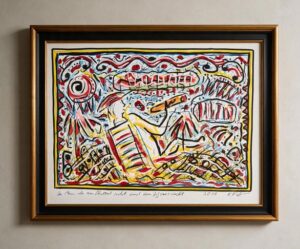
This image is simpler at first glance
than many of the great mythological or existential paintings. But I wouldn’t call it flat. Rather: seemingly casual. It depicts an almost banal subject. But Klaus doesn’t make it a vacation snapshot. He makes it an image of serenity amidst a vibrant world.
The man sits at the center, but not monumentally. He is not a hero, not a prophet, not a king, not a seeker, not a victim. He sits. He smokes. He is there. And that is interesting.

Because an incredible amount is happening around him: wave patterns, red markings, circles, black dots, sun or eye shapes, beach objects, perhaps boats, umbrellas, shifting sands, sea, sky, sounds, heat, human traces. The entire environment is full of rhythm. But the man himself doesn’t seem to be swallowed up by it. He sits in a kind of inner pause.
The beach as an in-between space
The beach is never just a place. It is a boundary. Between land and sea. Between everyday life and vacation. Between solidity and movement. Between body and horizon. Between time and timelessness.
A person sitting on the beach is thus sitting on a threshold. He appears to be doing nothing—and yet he is in a place where two worlds touch.
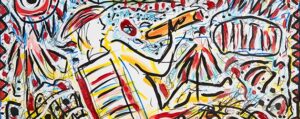
The image beautifully captures this in-between space. It doesn’t depict a tranquil, naturalistic beach landscape. It depicts a charged beach world, almost like an inner weather. The sea is not merely water. The beach is not merely sand. Everything is sign, movement, light, sound. The man sits within it like someone who no longer needs to intervene.
The cigar
The cigar is important. It makes the figure distinctive. A cigar represents pleasure, time, self-assertion, tranquility, perhaps even a slightly old-fashioned symbol of masculinity. It is not merely smoke. It is a ritual. The man is not frantically smoking a cigarette. He is smoking a cigar. This takes time. This demands slowness. It is a gesture of presence.
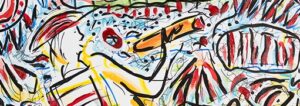
The image could therefore be titled: A person allows himself to sit in the world… Just to sit, to look, to smoke, to be present. That’s almost provocative today.
The color red
The red is striking. It’s not just warmth. It’s also a signal, heat, blood, sun, intensity, zest for life, perhaps even danger. The beach here isn’t pale and peaceful, but charged with energy. Red flows through the image like dynamism. Precisely for this reason, the man’s composure is more powerful. If the surroundings were calm, his serenity would be banal. But because everything around him is pulsating, his sitting takes on significance.
He isn’t calm because nothing is happening. He is calm even though everything is happening. That’s an important distinction.
Is the painting flat?
No—but it is intentionally less “heavy” than other paintings. It has a different kind of depth. Not a tragic depth, not a mythological weight, not an existential threat. Rather, it has the depth of an everyday moment that suddenly becomes visible as a state of being.
A man on the beach with a cigar can be very shallow if it’s just a cliché: vacation, enjoyment, relaxation. But here it’s not simply a cliché because the surroundings aren’t decoratively tranquil. The painting doesn’t depict the man as an advertising figure. He’s sitting in a world teeming with life. The question is perhaps:
How can a person simply sit still in a world full of stimuli, signs, and movement? That’s not shallow at all. It’s almost a philosophical question. Klaus takes this moment seriously enough to paint it. That’s powerful.
Because in doing so, he says: Even the simple things belong to the world. Enjoyment, pause, physicality, sun, beach, smoke, and doing nothing are also states of being.
Composition
The painting is very composed. The man sits in the center, but not rigidly. The shape of the deck chair creates a slanted, almost architectural structure. The cigar draws a line to the right. The head, with its cap, forms a distinct figure. Counter-spaces emerge to the left and right. A red wave band runs across the top like a roof over the scene.
The frame is strong. The yellow and black border holds together the wild internal movement. This allows the image to be very dense without falling apart. This is typical of Klaus: he allows the image great vibrancy, but he establishes an order that holds the whole together.
The Challenge
A seemingly simple image with many elements is difficult to balance. The man must not be lost. The surroundings must not be merely patterns. The red must not overwhelm everything. The beach symbols must remain vibrant, but the scene must remain legible. It should appear relaxed, but not arbitrary. It should be simple, but not empty. It should be full, but not chaotic.
The Man
The man is not psychologically overly explicit. You don’t know exactly who he is. But you sense his posture. He sits back, physically relaxed, at peace within himself. He doesn’t seem to be searching. Rather, someone who, for a moment, isn’t searching at all. This distinguishes him from many other KFH figures. Many people in Klaus’s paintings stand at a threshold, searching, carrying, protecting, fighting, being transformed. This man isn’t visibly undergoing a great transformation. He is in a state of being. That, too, is a state.
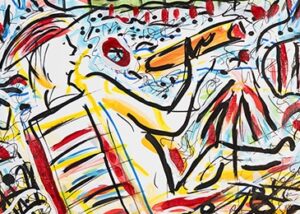
Perhaps one could say: He isn’t on a journey. He has arrived in the moment. Lightness without meaninglessness
The painting has a certain serenity. But it isn’t empty serenity. It shows a world that is hot, loud, colorful, full, and vibrant—and a person who finds a place in it.
It is perhaps one of those paintings that one initially underestimates. One thinks: a man with a cigar on the beach. But then the question arises: Why does this man seem so calm? Why is the world around him so charged? Why is the cigar so central? Why is the beach not peaceful, but almost cosmic?
Then you realize: The image is about a small human luxury—the ability to inhabit a moment.
My verdict:
I consider it a very valid image. It expands Klaus’s cosmos because it shows that his art can encompass not only the grand, the weighty, and the archetypal, but also the seemingly banal.
And perhaps that’s precisely what’s important: If everything were only grand and fateful, the cosmos would become too melodramatic. This image brings in pause, warmth, and earthly serenity. The man smokes his cigar while the world dances around him.
It’s a beautiful, human image. For me, this image is a small, powerful counterpart to the dramatic works: not the person before a major decision, but the person in pause. And perhaps that, too, is art: not missing the moment just because it seemingly demands nothing.
Key points:
The man is not sitting outside the movement. He remains calm within it.
The man is not sitting apart from the movement. The image appears simple because the moment is simple—but the moment is not empty.
In a world full of signs, this man allows himself to do nothing other than simply be.