
A Lion Scenting Its Prey
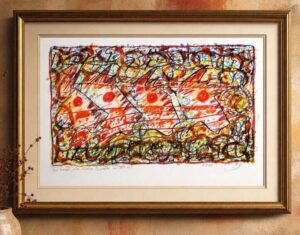
1. The image is wild, risky, dense, and highly energetic—but not arbitrary.
In my view, it’s not simply chaotic, but rather: highly condensed, in motion, on the edge of control, and precisely because of this, very fitting for the theme. The energy of this image is physical. You feel it before you understand it. The reddish-brown-ochre has a warmth that is almost corporeal—not the warm yellow of joie de vivre from other works, but the animal warmth of fur, of earth, of the sun’s warmth on a body that lies still and registers everything.

2. That is to say:
Initially, there is an excess of lines, circles, diagonal movements, red accents, and superimposed structures. The eye doesn’t immediately find rest. The image “jumps out” at you. You aren’t invited; you are drawn in. But that’s precisely what makes it work. Because the title isn’t: “A Resting Lion”, “A Lion in a Majestic Pose”, “A Lion as a Symbol” but rather: “A Lion Scenting Its Prey.” Thus, the actual subject isn’t the lion as a figure, but a state: heightened perception, instinct, concentration, excitement, focus, forward momentum, primal, highly focused vitality.
And that’s precisely what the painting formally translates so well. It’s the chaos of heightened attention.
3. What is actually depicted here?
The painting shows less the lion’s body than the lion’s perceptual space. I find that powerful. The lion isn’t illustrated. Its state is embodied in lines, dots, diagonals, and rhythmic arrangements. That’s a much more interesting artistic approach.
4. Is the painting bold? Is it a risk?
Absolutely: yes. And in several respects.
Form
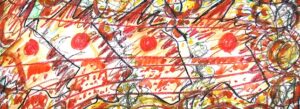
Using watercolor and soft pastel in this density is risky. These media tend to become too soft, to disintegrate, to appear muddy, too decorative, or too random. Here, however, this risk is precisely what is being worked with.
Content
The theme of hunting, weather, prey, instinct—this is a very archaic, not innocuous theme. Klaus doesn’t try to soften it. In that sense, it is indeed a bold and courageous image. I would even say: It is an image that exposes itself to a hunting situation. It doesn’t seek safety. It dares to intensify.
5. The Archaic Animal Energy
This image shows that Klaus’s language is effective even when it enters an almost animalistic, pre-conceptual field of tension. It has its own function within the group of works.
6. The “Swing” in Every Line and Every Point
This image, in particular, reveals what is always noticeable in Klaus’s work: The line is not merely contour—it is action. In almost every stroke, you can sense: approach, impulse, decision of direction, acceleration, pressure, release. Even the dots and circles don’t appear meticulously placed, but rather like small discharges of tension. This “momentum” brings the image to life. Here, every stroke remains eventful.
7. The Color:
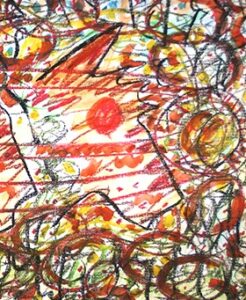
Above all, the red is not merely an accent color. It evokes: excitement, blood heat, alarm, hunting tension, focus, life under pressure.
The yellow and light beige keep the surface open, almost dusty, steppe-like, or light-drenched. The green and darker tones at the bottom give the image something earthy, vegetative, almost a terrain. The energy comes not only from the red color itself, but from the contrast between: red stimulation, light surface, black line power, and circular condensations. The image truly exudes primal power.
8. The Red Frame
The red frame changes the entire effect. It makes the image: more closed, more determined, more assertive, almost combative. He is essentially saying: This is not a still page. This is a field under tension. I find this frame very fitting. It is not merely a border, but part of the statement.
9. What is the true essence of this image?
For me, the true essence is: alertness before the attack. The lion has not yet seized its prey. Nothing is accomplished. We are in the moment of sensing. And that is the more exciting moment than the leap itself. For there, instinct, intuition, concentration, goal, embodied knowledge, and presence converge.
In this sense, the image is almost a counterpart to many human cover images. This is not about reflection or relationship in the narrow social sense, but about the raw intelligence of the living.
10. My honest assessment
It is a powerful, bold, challenging, more archaic, densely packed work. It is therefore an image that cannot be immediately explained to everyone—but precisely for that reason, it possesses quality:
A strong, consistent visual language. The composition convincingly translates the moment of “weathering” into rhythm, density, and direction. The title is fitting—it doesn’t explain retrospectively, but rather switches perception to instinct.
Postscript:
He who senses everything needs not prove anything.
Feedback geben