
A Body-Painted Woman with a Zebra in Front of a Cinema
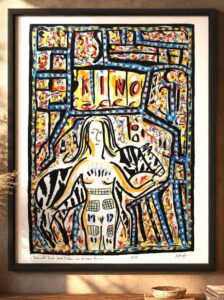
“Body-Painted Woman with Zebra in Front of a Cinema”
is a very powerful image because it places the zebra in a completely different world: not in nature, not in the desert, not solely in myth, but in the modern world of images, projections, facades, and public gazes.

Here, a woman stands in front of a cinema. This is crucial. She is not inside the cinema. She is not on the screen. She stands in front of it. This means: she stands before the world of images—but she is not simply swallowed up by it.
The letters KINO (CINEMA) stand like a large symbol above the scene. The image almost resembles a cinema facade, a city, an entrance, a stage, an illuminated evening space. It is modern, loud, public, almost urban. And in front of it stands this woman with the zebra.
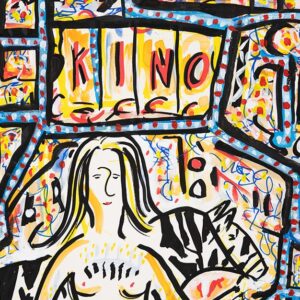
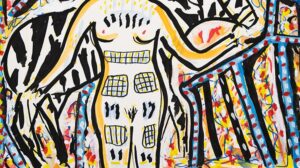
The woman is central, upright, calm. She does not appear insecure. She is painted, but not in disguise. The markings on her body do not appear to be archaic tribal paintings, but rather modern: grids, windows, fields, small black markings, yellow raster patterns. Almost as if she herself were carrying the city, the canvas, the patterns of the present on her body.
This is very interesting:
The woman isn’t simply “natural” in contrast to modern cinema. She already carries modernity within her. But she remains human. She doesn’t become an advertisement, a poster, a commodity. Her body is marked, but not lost.
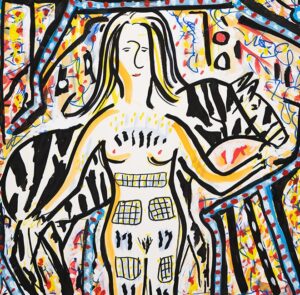
The zebra stands behind her—and for me, that’s one of the most profound aspects of the image.
It’s not in front of her like a trophy. It’s not beside her like a decorative companion animal. It’s behind her like a force from which she comes or on which she can rely.
The zebra behind the woman acts like a second nature, a support, a shadow being, a wild origin. It doesn’t dominate the foreground, but it’s strong enough to carry the entire image.
One could say:
She steps before the world of images—but behind her stands wildness. This prevents the image from becoming a harmless cinematic image. It becomes an image about public life, identity, and inner source. Who stands before the cinema? A modern body, a painted woman, a woman with symbols, a woman with a zebra. She brings something that the cinematic world cannot create: vibrant wildness.
The question of the halter is important.
The zebra is clearly wearing something like a halter or a lead. But for me, that doesn’t simply mean: the zebra is tamed. In Klaus’s world, that would be too simplistic. A zebra remains a zebra. In a real sense, it cannot simply be drawn into the human order like a horse.
But in painting, a different relationship can become visible. Here, the halter is perhaps not submission, but connection. A line of relationship. The woman isn’t holding it tightly, aggressively, or triumphantly. It’s not an image of control. It seems more like a silent understanding within the picture. The zebra isn’t broken. It is present. That is a significant difference.
Precisely because the cinema in the background represents the world of projection, the zebra almost becomes its antithesis: it is not an invented image, but an untamed symbol of life. In front of the cinema, where images are normally shown, a woman suddenly appears with an animal that itself looks like a living image. The zebra bears its markings on its body; the cinema produces images on screens. This is a wonderful tension.
The zebra is nature as image. The cinema is culture as image. The woman stands between the two.
The woman’s paint connects these worlds.
She is not “naked” in the simple sense. She is described. Her body has become a surface of signs—but not in a degrading way. She appears sovereign. Her stillness is almost unsettling because everything around her glows, flashes, circles, and calls out.
The image thus depicts not just a scene, but a question:
What happens to humanity in a world of images? Does it become a projection itself? Or can it become visible without losing itself?
This woman does not seem to lose herself. She is modern, but not artificial. She is visible, but not available. She is painted, but not masked. She is connected to the zebra, but not its owner.
Compositionally, the image is very powerful.
At the top, the cinema as a horizontal sign; at the bottom, the woman as the vertical center; to the side and behind her, the zebra’s body as a black-and-white force field. The blue lines resemble roads, light strips, architectural bands, perhaps even electrical wiring. The red and yellow dots lend the scene a touch of neon signage, a fairground, a movie night, an urban celebration.
The image is dense, but not chaotic.
It has an almost poster-like power. From a distance, one could read it: woman, zebra, cinema. And up close, it begins to multiply: pattern, window, sign, body, animal, public sphere, visual world.
This is very KFH: first a clear, almost simple scene—then a growing depth.
It is reminiscent of earlier images of women and zebras,
but it is different. In “Woman with Zebra,” the zebra was almost a spiritual counterpart or a force of nature above and beside the woman. Here, it has entered the modern public sphere. It is not in a mythical space, but in front of a cinema. This makes the subject more topical, more social, more public.

The image perhaps says:
The modern woman does not enter the world of images without her wildness. Or: She does not enter the public sphere as a role, but with her untamed nature behind her.
For me, this image resonates deeply.
It is perhaps one of the clearest images of Klaus’s relationship to the present: archaic animal power meets the modern visual world. Body meets sign. Woman meets public sphere. Cinema meets zebra. Everything is visible, but nothing is fully explainable.
The cinema is a place where people look at images. This image reverses the situation: now the image looks back.
The woman in front of the cinema is neither a spectator nor a film star. She is an apparition who does not simply surrender to the image market. The zebra behind her prevents her from becoming mere surface.
The cinema is a place where people look at images.
This image reverses the situation: now the image looks back. For me, this is a very powerful “post-zebra” painting:
not part of the completed cycle, but proof that the zebra lives on as a free symbol. Here, it leads not through myth or nature, but through modern visual society. And the painting asks quietly but powerfully: Can a human being remain alive, marked, sensual, sovereign, and connected to wildness—even in front of the world’s cinema?
Key statements:
The zebra is not tamed; it has entered into a relationship that is only possible within the image.
Before the cinema, not a film appears, but a living counter-image: woman, wildness, and the public sphere.
She does not become the image of the world. She brings her own image with her.