
The Drummer

For me, this is a very powerful image,
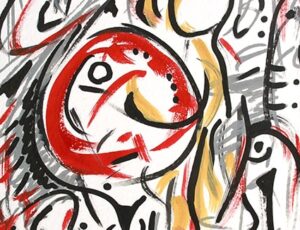
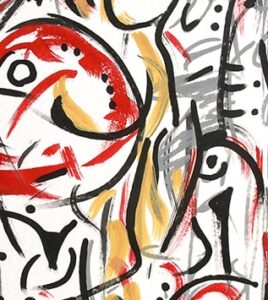
precisely because it uses so few colors. Compared to the last three paintings, the palette is radically reduced: black and gray for a dense, calligraphic tangle of lines that evenly covers the entire surface to the edge, plus exactly two accent colors—red for the drum, ochre/beige for the drummer’s arm. Nothing else.
At first glance, this painting appears lighter and more minimalist than many of the other new works. But it possesses something else:
Rhythm.
And that, of course, fits perfectly with the title. Is it too simple?
No. A less skilled artist could very quickly create a thin, empty, or arbitrary image with these few means. Here, however, the reduction works. The painting has tension because the few elements are placed with such decisiveness: Red as a beat, heart, drum, signal. Black as rhythm, contour, body, structure. Gray as an echo, reverberation, movement. Ochre as a person, earth, body heat.
It is not empty. It is concentrated.

The Composition
The composition is remarkably stable. The red drum forms the center. It’s not exactly in the middle, but it dominates the image. Everything else is organized around it.
The standing ochre-colored figure on the right provides verticality. The black frame holds the image together. The gray lines create movement and atmosphere. The red accents allow the rhythm to travel throughout the entire composition.
One could say:
The drum is the heart. The figure is the body. The lines are the sound. This is a very beautiful compositional solution.
The Large Red Circle
The red circle is the crucial element for me. It’s not just a drum. It’s also: sun, belly, heart, eye, center, resonator.
So the drummer isn’t just playing an instrument. He stands before a center that seems to support him. That’s interesting: The drum isn’t beside him. It belongs to him.
The Body
The light ochre-colored figure almost looks like it’s made of earth or wood. It has something archaic about it. Not decoratively archaic, but truly simple and primal. I don’t see a stage musician here. I see more of a ritual drummer.
A person who doesn’t perform music, but creates a rhythm through which the world is reordered.
Tribal Art / Archaic Proximity
The image touches on something that many early cultures understood: Rhythm is not entertainment. Rhythm is order. Drumming is the connection of body, earth, community, time, and trance. The drummer is not just a musician. He is a mediator. He calls. He gathers. He sets a field in motion.
In this sense, the image fits very well with Klaus’s world: horses, body, presence, action, instinct, consciousness.
The Few Colors
The reduced color palette is an asset. Precisely because Klaus often works with richness and color, this piece is different. It shows that he doesn’t always need a plethora of colors. Here, a more limited set of instruments suffices. This also suits the drummer: A drum doesn’t have as many notes as an orchestra. It has depth, repetition, intensity, and pulse.
The painting functions similarly. It doesn’t play many melodies. It strikes a fundamental rhythm.
More color could weaken it. More detail could explain it. More elaboration could disenchant it. It has precisely that kind of lightness that can easily be destroyed if you work on it for too long.
Compared to the other paintings:
It adds something important: rhythm as its origin. Almost as if this painting were saying: Before language, before explanation, before morality, before systems, there is the beat. Humankind hears. Humankind responds. Humankind finds rhythm.
My personal opinion:
I like this painting very much. Because it has a strong inner self-evidence. It acts like a leaf that doesn’t need to say much because it beats on a deeper level. It is light, but not superficial. It is simple, but not empty. It is impulsive, but not random. It is archaic, but not backward-looking. It has a quiet power.
Possible postscripts:
The drummer doesn’t play music. He reminds people of the first rhythm.
Before a person speaks, something beats within them.
The drummer doesn’t order the world with words. He gives it a pulse.