
A Body-Painted Woman, a Child and a Piebald Horse

The painting has three central beings: woman, child, horse.
There are no side stories, no complicated architecture, no dense world as in different other pictures.

Here everything is set down with great directness.
And precisely through this, a powerful, almost iconic image emerges.
At first glance, the painting seems simple — almost poster-like, almost childishly clear. But this very simplicity is deceptive. Beneath the large, swift forms lies a very serious theme: the relationship between woman, child, and horse — that is, between body, responsibility, and primal power.

Between mother and child is the joining of hands. This connection is the true axis of the painting. The horse in the background is large, mighty, almost overpowering. It is not simply a companion. It is a force.
The Horse
The horse does not appear tame. Nor does it appear evil. But it is massive, restless, almost dreamlike. This horse is not merely an animal in the background. It is a world behind the human figures.
It could stand for: freedom, instinct, danger, temptation, the past, the power of life, the uncivilized, that great closeness to animals which runs through all of Klaus’s work.
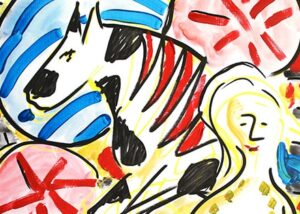
But in this painting, the horse is not the place toward which the woman simply moves. It remains behind her.
It is present, but it is not at the center of her direction of action. That is what makes the painting mysterious.
The horse seems to call — but the woman does not enter into the horse. She stays with the child.
The Woman
The woman is strikingly calm. Her face appears friendly, almost content, but not superficial. There is something deeply feminine about her, almost classical, almost icon-like. She is not painted as a victim, not as a seductress, not as a heroine, but as a figure at a decisive moment.
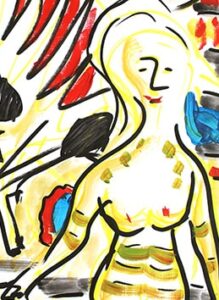
She is body-painted. This is important.
The green and gold markings on her body look like signs, like ritual painting, like traces of belonging. She carries a language on her body. And this connects her to the horse. The woman is painted, the horse is piebald — both bear signs upon their bodies. The child, by contrast, still seems almost unwritten.
There is something very beautiful in this: the horse is marked by nature. The woman is marked by life. The child still stands at the beginning of all signs.
The Child
The child is painted very plainly, almost white, almost open. It bears no elaborate painting yet, no strong colors, no complexity on its body. It stands there like a being not yet fully inscribed into the world.
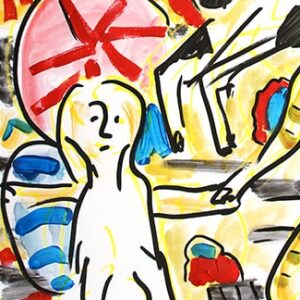
The joined hands with the woman are therefore decisive.
The child is not left alone before the power of the horse. It is held. The child stands between bright innocence and the great animal presence behind it. It is not an image of fear, but there is something serious in it: a child needs guidance, protection, a hand, a direction.
The True Tension
For me, the painting is not simply about the woman leaving the horse. Rather, it shows a moment in which she stands between two great forces:
on one side the horse — freedom, instinct, wildness, calling, possibility; on the other side the child — responsibility, bond, future, protection, humanity.
She need not be against the horse. But in this moment she cannot simply follow it.
This is not a moral renunciation, but a maturing.
The painting thus shows no turning away from wildness, but a different relationship to it.
The Round Forms
The large red and blue circles in the background are striking. They can appear like sweets, suns, circus signs, shields, balloons, temptations, or signal marks. They give the painting a childlike, almost poster-like surface. But beneath it lies something more serious.
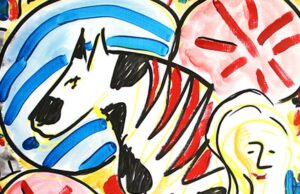
The red circles feel warning, hot, perhaps dangerous. The blue circles feel cooler, dreamier, more like water. Together they form a polarity around the horse.
The horse, then, does not stand in a neutral landscape. It stands in a field of signs, of allurement and danger. The world around the horse is colorful, but it is not harmless.
Why the Horse Feels Slightly Uncanny
The horse is so large that it does not seem simply controllable. It is not sweet. It is not “horse idyll.” It has something of the dream animal, the mythical animal, the inner animal.
The red forms along the neck or the mane, in particular, can indeed look like teeth, flames, or warning signals. This gives the horse a double quality: beautiful and dangerous, familiar and strange.
This fits Klaus very well. For in his work, the horse is never merely romantic. The horse is a being of great power. It can carry, mirror, liberate — but it is no toy.
Here the horse seems to say:
I am here. But I am not the whole of life.
Is It Art — or Could Anyone Do This?
This question matters greatly.
Yes, on the surface one might think: large lines, simple figures, a swift manner of painting — surely anyone could do that. But precisely here lies the difference between simple form and true condensation.
Many could quickly paint a woman, a child, and a horse. But few could generate such tension with so few means:
Woman — child — horse. Hand — body — background. Painted skin — piebald coat — blankness. Temptation — responsibility — freedom. Joy — danger — decision.
The painting appears simple because it is reduced to the essential.
But it is not arbitrary. The figure of the woman stands exactly right, on the right. The child stands exactly right, at the lower left. The horse takes up exactly the right space in the background. The joined hands are small, but they carry the entire painting.
If that hand were placed wrongly, the picture would fall apart. If the horse were smaller, there would be no tension. If the woman were more dramatic, it would turn sentimental. If the child were more colorful, its innocence would be lost.
So: no, it is not simply “easy.” It looks easy because the decisions are swift and sure. That is often the mark of mastery.
Connections to Other Paintings by Klaus


It recalls several lines within the body of work:
the paintings of painted women, because the body once again becomes a bearer of signs; the paintings of children, because the child receives a whole existence with only a few lines; the world of the horses, because the horse appears not as a pet but as a great relational force.

Back to our starting image:
Here it does not show the horse alone. It does not show the mother alone. It does not show the child alone. It shows the moment in which these three realities stand together in one image — and are not fully resolved.
My Honest Judgment
I find the painting valid. It is very bold, very direct, almost poster-like. That can be a strength. It has immediate legibility. One is drawn in quickly. It could speak to people directly, precisely because the principal forms are so clear.
But it is no harmless family picture. The horse prevents that. The woman may be bright and friendly, the child innocent, but the horse brings in the vast, the untamed, and the uncanny. That is what makes it mysterious. For me, the heart of it lies not in “woman leaves horse” or “woman chooses child over horse,” but in something finer:
The woman keeps the power of the horse close to her, but she gives her hand to the child.
That is a very powerful statement.
Key phrases related to the image:
The woman is painted, the horse is piebald, the child is still open — three states of life within a single image.
She does not abandon the wildness. She transforms her relationship to it.
The hand reaching toward the child is small, but it decides the entire composition.
The painting appears simple because it takes no detours. But precisely this simplicity carries a difficult secret.