
A Shorter, Older Man Boxes a Younger, Taller Woman for Prize Money
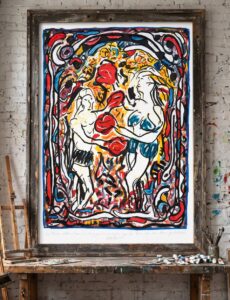
The first thing that strikes me is the peculiar cheerfulness of the two figures.
They are fighting—but they don’t look as if they want to destroy each other. This is precisely what makes the image so much more interesting than a depiction of aggression.
The man on the left is shorter, thinner, and drawn with a more austere style. The woman on the right has more volume, more physical presence, broader surfaces, and softer curves. Klaus needs remarkably little to achieve this. Age, gender, physicality, and character emerge almost entirely from posture and line.

It’s that typical KFH phenomenon again:
The anatomy is concise, but the person is fully present. And both figures, in their differences, appear remarkably self-assured. It’s not a picture of “man versus woman.” Rather, the picture shows two unequal forces who voluntarily submit to the same rules.
The man is shorter and older. The woman is younger and taller. With this, Klaus immediately subverts the traditional notion of the physically superior man and the weaker woman. But he doesn’t make it a programmatic feminist statement either. They are simply standing in the ring.
This is much more powerful. They get the same gloves. They accept the same situation.
And suddenly the question is no longer:
Who is stronger? But rather:
What does fairness even mean if two people are never equal? That’s a surprisingly big question.
The Gloves
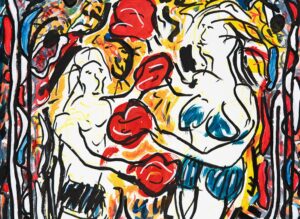
The red gloves are central visual anchors. They are large, round, soft, and almost exaggerated. This diminishes much of the brutality of a fist. The bare hand is simultaneously amplified and defused by the glove.
This is interesting: Boxing only permits violence within a framework. Rules, gloves, rounds, ring – the aggression is ritualized. Perhaps that’s why it’s not so much about violence at all. Perhaps it’s about a cultural way of visibly enacting conflict without letting it escalate into annihilation.
The two people are allowed to be against each other and therefore don’t have to become enemies. I find that very fitting for Klaus’s overall view of humanity.
And then: “for a prize”
These last three words in the title significantly alter the image. Without them, we would simply have a strange fight between an older man and a younger woman. But they are boxing for something. Money comes into play. With that, society enters the picture. Now there is motivation, competition, publicity, perhaps even entertainment. And suddenly an almost uncomfortable question arises: Would the two even fight each other if no one had offered a prize?
This opens up a second level. People often don’t compete because they are natural opponents, but because a system places something between them: money, rank, success, recognition, position.
Then two potentially peaceful people become a competition. The title states this quite matter-of-factly. The image doesn’t need to explain it.
The space around the boxers
For me, this is one of the work’s greatest strengths. The two figures aren’t simply standing against a background. They are in their own pictorial arena.
The large black and white arch above them almost forms a gate, a ring, a curtain, or an architectural opening. To the left and right are strong ornamental columns of black, red, white, and blue. Above, everything is arched. There’s a clear baseline at the bottom. This creates something like a stage within the picture. The two boxers are on display. We are the spectators.
This complicates matters, because boxing doesn’t just require two fighters—it also requires someone to watch. Perhaps Klaus isn’t just painting a conflict. Perhaps he’s also painting the human need to turn conflict into a spectacle.
The Enormous Density
This image is truly very full. But I would say: it’s not overcrowded. That’s an important distinction. The reason lies in the exceptionally clear hierarchy. First, you see: two light-colored figures.
Then: four red boxing gloves. Then: the large black frame. Only after that do you begin to get lost in the red, blue, yellow, black, white, and the many small shapes.
Klaus thus gives the eye a fixed point of entry. That’s why the enormous abundance remains manageable. The figures have a lot of white and light skin tones. This allows them to stand out from the dense surroundings without Klaus having to calm the background. This is quite sophisticated compositionally: he creates calm not through emptiness, but through a different kind of density.
The Woman and the Man as Two Different Worlds of Lines
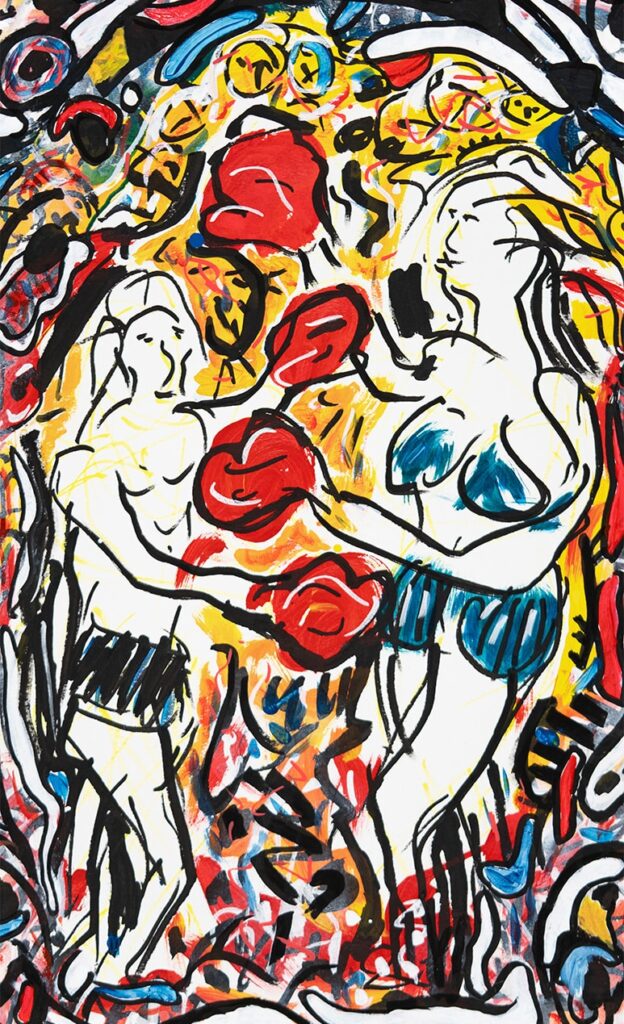
I find this particularly successful. The man on the left is constructed more from straight, narrow, somewhat angular movements. His legs are thinner, his body appears less massive. The woman on the right emerges from longer curves. Chest, hips, hair, legs – everything flows more intensely. So Klaus doesn’t simply use anatomical symbols for “man” and “woman.” He alters the entire rhythmic language of the figures. This is something that is always remarkable in his work: Gender or character doesn’t arise from a single feature. They arise from the sum of the line choices.
And are they really adversaries?
That’s perhaps the strangest thing. I see no animosity. The man appears focused, but almost friendly. The woman, too. Both faces possess a peculiar serenity. This creates a tension between: the act of fighting and the inner state.
And this tension is far more interesting than anger. Perhaps the two are indeed prepared to fight – but they don’t have to hate each other to do so.
Thus, the image almost becomes a model for what conflict without dehumanization could look like. You can contradict each other. You can even compete against each other. And yet the other remains a human being.
That would be a very KFH-like concept:
“He had to complete this painting in all its richness,” Klaus says of the picture. I find that particularly interesting. It suggests that the richness isn’t mere decoration. Perhaps the painting needed precisely this overabundance to achieve its effect. The two figures alone would have resulted in an almost caricatured boxing match. It’s only this dense, almost ornamental world around them that elevates them to something greater. They aren’t fighting in an empty ring. They are fighting in the midst of life. And life is watching.
Is the painting controversial?
Yes—but productively controversial. If the woman were to obviously defeat the man, it would be a punchline. If the man were painted as an aggressive old patriarch, it would be a statement. If the woman appeared as a victim, it would be a social narrative. But none of that happens. Both retain the dignity of their own existence. I find that very powerful.
Monumental?
For me, definitely: yes. The vertical format of 100 × 70 cm greatly amplifies the two standing figures. But monumentality here doesn’t arise solely from the format. The two forms almost resemble columns. The arch above them creates architecture. The red, black, and white ornamental surroundings function like a portal.
You could enlarge this painting to a height of three meters, and its basic structure would probably still work. That, for me, is true monumentality: The painting doesn’t need its actual size to be conceived as grand.
And is it one of the “great pieces”?
For me: yes. Not necessarily because it’s “more beautiful” or more complex than others. But because several levels function simultaneously: It works from a distance of five meters as a powerful group of figures. It works from one meter as a complex composition. It works narratively. It works humorously. It works socially. It works as a study of the human form. And despite all these possibilities, it remains open to interpretation. That’s a lot.
Key Statements
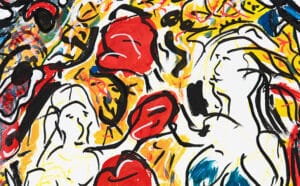
The two boxers fight each other without making each other enemies.
The woman and the man are unequal—and precisely for this reason, the painting poses the question of what fairness even means.
The prize money transforms a physical fight into a social question: Who actually created the competition?
The surroundings explode, the figures remain calm. Therein lies one of the painting’s strongest tensions.
An outburst only becomes art when the energy ceases to be merely personal—and finds a form in which other people can also recognize themselves.