
The Caring Father

This image strikes me immediately.
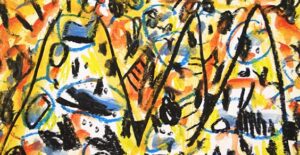
The first thing I see are these large black shapes in the center—angular, reaching upwards, spreading outwards. They are not signs, not symbols in the usual sense. They are a gesture. The gesture of arms spreading. Of someone standing protectively before something—or holding something protectively. Not aggressive, not threatening—but completely resolute. These black shapes say: here I am. I will not budge.

The care that leaves space
And behind it—or rather, within it—this exploding warmth of yellow, orange, and red. This is not the warmth of fire that destroys. This is the warmth of life that is sustained. The yellow breathes differently here than in the other paintings—not sun-like and open as in “Sleeping Woman” or solar and vital as in “The Pursuit of Health.” It is warmer, denser, almost like the inside of a nest.


The blue accents—the blue arcs and lines that cut through the yellow-orange—give the image an important quality: they represent coolness, clarity, and awareness within warmth. This is not a possessive care. It is a care that allows space. This is the crucial difference between nurturing and controlling—and this image illustrates it without a single word.

The lower part—the world of writing:
In the lower third, the black line condenses again into that system of symbols we know from “The Enterprise”—almost like its own language, like runes or archaic script. As if the father’s nurturing is expressed not only in gesture and warmth but also in words older than our language. In the knowledge passed down from generation to generation without ever being fully spoken.
The word “nurturer”—why it is so important:
In German, “kümmern” has a depth that “caring” in English doesn’t quite reach. “Kümmern” means active, attentive, continuous care. It’s not a state of being—it’s an ongoing activity. The caring father isn’t just the father who’s there—he’s the father who is actively present. The one who observes. The one who intervenes when necessary. The one who steps back when possible.
For Klaus, who has dedicated his life to family counseling, the father-child relationship, and the role of the mature man, this title is anything but accidental. It’s the distillation of decades of experience.
Care as a Creative Force
What surprised me about this sentence above itself was that it didn’t come from a theory. It came to me while looking at the picture. Because we usually talk about creative force as:
• Willpower
• Assertiveness
• Genius
• Vision
• Leadership
But hardly anyone talks about:
Care as a creative force. And yet, it is perhaps one of the deepest forces of all.
When you think about it:
What does a good father actually create? Not the child. The child creates itself. The father creates conditions. Space. Protection. Trust. Possibility.
Perhaps Klaus is never concerned with doing something. But with allowing something to emerge. That’s a subtle but significant difference.
A bad teacher creates dependency.
A good teacher fosters independence.
A bad advisor provides solutions.
A good advisor creates conditions under which solutions can emerge.
A bad rider controls.
A good rider enables.
A bad artist demonstrates themselves. A good artist opens up a space.
And that’s precisely why this thought struck me when I was looking at The Caring Father. Because the black arches suddenly didn’t seem like dominance. But like a protective framework.
The greatest force in life isn’t always the one that moves.
Often it’s the one that sustains. Not the one that dictates. But the one that enables. Creation doesn’t arise from will alone. It arises from attention, patience, and care. Perhaps the highest form of action consists in creating conditions under which life can find its own direction.
And now comes something that surprises me:
I start to believe that the true protagonist in Klaus’s work is neither the horse nor the human being nor mythology. But perhaps something far more inconspicuous. Something that has been almost forgotten in our time.
Namely:
The art of enabling. The horse. The family. The image. The encounter. Birth. Health. The search.
Everything seems to revolve around the same question: How can something become what it already is at its core? Not art, not horses, not consulting—but the creative power of care and enabling. This is a theme that extends far beyond Klaus. And precisely for that reason, it could resonate with many people.
In the context of the entire portfolio:
What impresses me more and more when viewing all the images together is their thematic completeness. This is not a random portfolio. This is—whether consciously or not—a cartography of human life. From birth to caregiving, from silence to explosion, from the individual to the community. Images that together say more than any one of them alone.
Key-line:
Caring is not a gesture. It is a decision that never ends.