
A New Garment That Actually Changes You in a Positive Way

This one is a celebration:
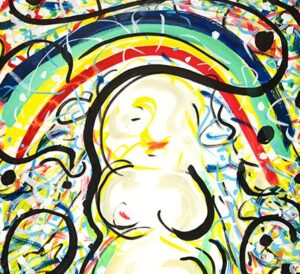
that woman in the middle is drawn with maybe twelve lines total, and yet she holds the whole A1 sheet.
At first one expects fabric, protection, fashion, identity, maybe social appearance. But Klaus paints a figure that seems almost naked, open, vulnerable, exposed — and yet not ashamed. That is fascinating. So perhaps the “new garment” is not clothing at all.
Perhaps the new garment is:
- dignity,
- self-acceptance,
- a new inner form,
- a new aura,
- a new relationship to one’s own body,
- a new way of standing in the world.
This would mean:
The true garment is not what covers the woman. The true garment is what allows her to appear. That seems very strong to me.

The Figure
The central figure is very clear. She stands upright, frontal, almost iconic. She is not hidden. She is not collapsing. She is not seducing. She is not defending herself. She simply appears.
That is important. The painting is not erotic in the usual sense. It is much more archetypal. It feels closer to a fertility figure, a goddess figure, a primordial female form — but translated into Klaus’ wild contemporary language. The body is soft, pale, almost luminous. Around it everything moves intensely. The woman is calm, but not passive. She is the calm center of a turbulent field.
The “Garment” as Energy Field
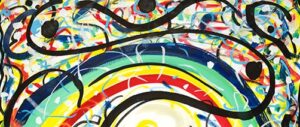
The border and surrounding lines function almost like a garment. The black curves on both sides could be seen as protective side-forms, almost like two living columns, two guardians, two streams of energy. The rainbow-like arc above her also feels like a mantle or canopy. So while the body itself is uncovered, the picture gives her another kind of clothing: a garment of forces. The surrounding field dresses her in life.
This is perhaps why the title works so well. The visible body is undressed, but the invisible being is clothed in transformation.
Masculine Drawing, Feminine Outcome
The line is rough, direct, almost forceful. The black strokes are not delicate in a conventional feminine way. They are bold, decisive, even masculine in their energy.
But the result is not hard. The result is soft. That is one of the most interesting qualities of the picture. The masculine force of the line does not violate the feminine form. It protects it, frames it, and gives it presence. The roughness gives the figure strength. Without that roughness, the image could become too sweet, too decorative, too “beautiful” in a weaker sense.
Here the woman is not made fragile. She is made present.
Composition
The composition is very strong. The woman stands almost exactly in the center, which is always dangerous. A centered figure can easily become static. But here the surrounding movement prevents that. The picture is organized in three layers:
- The central vertical figure — calm, pale, open.
- The strong black side-forms — protective, rhythmic, almost architectural.
- The colorful outer field — life, noise, transformation, atmosphere.
This creates a powerful tension: stillness in the center, movement at the edges. That is why the picture does not fall apart. It is wild, but it has a clear inner architecture.
The White Body
The pale body is important because it is not heavily painted. It seems almost reserved from the chaos. This gives the figure a special innocence. Not childish innocence. More like original dignity. She is not constructed out of the surrounding noise. She stands inside it, but remains distinct. That could be the deeper meaning of “positive change”: To be changed by life without being lost in it.
The Contemporary Theme
Today women are often surrounded by extreme demands:
- be strong,
- be attractive,
- be independent,
- be young,
- be successful,
- be desirable,
- be protected,
- be open,
- be untouchable,
- be everything at once.
This picture does not answer that in a social or ideological way. It gives a much deeper answer: A woman does not need to disappear beneath roles in order to be transformed. The new garment is not a costume. It is not a mask. It is not social armor. It is a new state of being.
Does the Picture Work?
Yes, I think it works very well. It is not one of the most “complicated” pictures, but it is one of the most immediately readable. It has strong poster-power. From a distance, the figure is clear. From nearby, the surrounding field becomes rich and alive. It also belongs strongly to the group around:
- A Woman Who Is Not Afraid of Growing Older

2026 | Acrylic on Paper, 65 x 50 cm - A Woman Who Seeks a Man

2026 | Oil Pastel and Acrylic on Paper, 40 x 50 cm - The Wedding

2026 | Acrylic and Watercolor on Paper, 85 x 60 cm - A Good Decision

2026 | Acrylic on Paper, 50 x 40 cm


But this one adds something new: female transformation without loss of essence.
My Honest Impression
I like it. It is bold, perhaps even dangerous, because it could easily have become too literal or too decorative. But it does not. The figure remains open, dignified and strangely protected.
It is not a picture about nudity. It is a picture about appearing. And maybe the deepest sentence would be:
She is not undressed.
She is clothed in herself.
The new garment is not fabric.
It is the courage to appear without disguise.
What truly changes her does not cover her.
It reveals her.