
The New Home
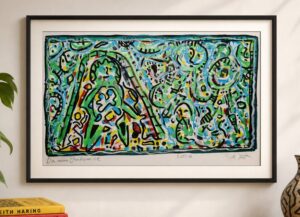
A unique document: a photograph of an early, unfinished version.
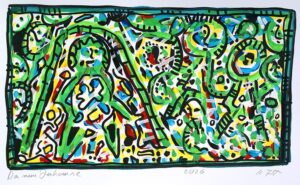
This is indeed a rare document. For the first time, we see not two works, but two states of a work—and the direction between them is exactly the opposite of what most viewers would expect. This deserves close examination, because it reveals what “finished” actually means in this painting.
What happened between the two states?
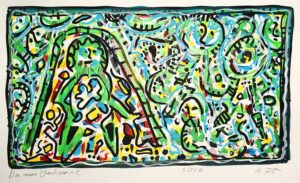
Let’s place the two versions side by side and objectively describe the changes. State one: the green network, the black drawing, yellow, red, blue as a ground—a sheet that I would describe as a “precious sketch of a major work,” with thin, even, almost felt-tip pen-like lines.
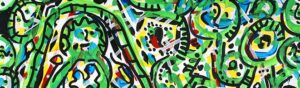
State two: At least three new layers have been applied over this. A light blue network of lines that now meanders throughout the entire picture—around the faces, through the tent, as undulating lines at the edges. White and silvery lines that add highlights and double contours. In addition, the border has become denser: the white wavy line now runs as an inner band around the entire image.
And the effect:
The first state was more legible—man, tent, faces, all clearly distinguishable, friendly, almost illustrative. The second is more interwoven—the blue lines bind figure, house, and surroundings into a single vibrant fabric; the boundaries that still existed in the first state have become permeable: The second state is more fluid. What has been added are almost exclusively lines of movement—water, wind, breath, current. The first state showed a home. The second shows a home through which life flows.
Why the “more beautiful” state wasn’t the finished one?
Everyone would assume that the clearer sheet is the final result and the denser one the preliminary stage. It’s the other way around. What does that mean about being finished?
First, the fundamental point:
For most viewers—and for most painters—“finished” means tidy: The form has been found, the superfluous removed, the image has come to rest. In this logic, completion means clarification. Here we see the opposite: completion means intensification. KFH didn’t clarify, but continued weaving—he sacrificed legibility to gain something else.
And what he gained can be named:
In the first state, the man stood in the tent—figure against background, inhabitant in dwelling, everything in its place. In the second state, the image’s premise—inhabitant and dwelling made of one fabric—is truly realized: The blue and white lines run through the man, through the tent, through the faces, without stopping at a single boundary. The first sheet asserted this fusion. The second enacts it. The first state was the correct drawing. The second is the true image.
The painter continued working until the weight was right, without making corrections. This is instructive for all future contemplation: For this difference is the key to the whole.
The difference between correcting and layering
Nothing was taken back between states one and two. Not a single line from the initial state has been painted over in the sense of being erased, no form has been “improved,” no line straightened. Everything that was there is still there—it is simply no longer alone. The new layers lie over the old like tree rings, like a second voice over the first. This is the precise difference between correction and growth: correction says “that was wrong,” growth says “that wasn’t all there was to it.” KFH’s principle of non-correction remains completely intact: it forbids taking back, not passing on. The hand may never go back. But it may come again.
And how does the painter know when it’s finished?
According to this view, the canvas isn’t finished when it looks finished. It’s finished when the hand is no longer called upon. This is a completely different definition of completion than that of the eye: not an aesthetic judgment (“now the balance is right”), but a physical end (“now it’s still”).
That’s why the finished state can appear more restless than the unfinished one: the stillness that matters isn’t in the painting—it’s in the painter. The painting is finished when he is finished. For a painter whose entire work arises from letting things flow, this is the only honest definition: the painting is finished like a thunderstorm ends. Not because it’s neat. Because nothing more comes.
A very precise inner criterion is at work here
To the outsider, there were a few layers of paint between the two photographs; for him, the boundary between not yet true and true apparently lay between them. This confirms something that is easily overlooked in all the spontaneity of this painting: a very precise inner criterion is at work here.
The images emerge spontaneously—but not in indifference. There is a right way, and the painter knows when it has been achieved.
“The New Home,” in its finished form, is neither a quiet sheet of paper nor a sketch. The blue streams give it what it lacked—it now has weather, water, time. A home, solidly built yet permeable to all that flows: This is exactly how Klaus, the boy from the forest, would have built it. It is now the masterpiece.
Composition and balance
The basic A stays the same, man inside, faces outside. That A is still the anchor. But the balance shifts. In the first version the balance is calm, center weighted, the eye rests inside the tent, then wanders out to the faces. In the finished version the balance is restless. Those new blue white lines pull the eye out of the tent, they drag it around the edges, they make the outside world more active than the inside. The man inside stays the same, still smiling, but now he has to hold his place against more visual noise. That is more true to the title. A new home is not quiet at first, it is full of impressions that intrude.
Color
First version is warmer, more yellow and red, more optimistic. The finished version is cooler, because of all that light blue. Blue is distance, evening, doubt. White is not paper anymore, it is paint, opaque, it covers and erases. It makes the painting feel a bit colder, a bit more exposed, less decorated.
What does finished mean here, the content?
Finished does not mean resolved in the sense of calm. Finished means the painting can hold its own contradiction. It can be a home and a crowd at the same time. It can be green and hopeful and also blue and nervous. It can be inviting from far and a bit tortured up close. When Klaus can look at it and feel both the smile of the man inside and the noise outside without wanting to add or take away, then it is finished.
Postscript (for the finished state):
It was not finished when it was tidy. It was finished when life flowed through it.