
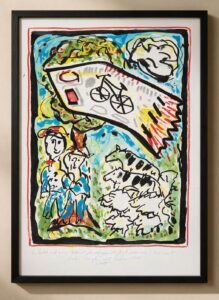
A Rocket with a Bicycle Painted on It Flies over a Meadow with Children, Sheep and Cows
I find this picture very interesting.
At first glance, the picture is surprisingly easy to read. But this simplicity is deceptive because two worlds collide that don’t actually belong together. Below is the slow, the physical, the earthly:
Children. Sheep. Cows. Grass. Tree. And above it flies a rocket—almost the most extreme symbol of speed, technology, distance, and leaving Earth. And then Klaus paints a bicycle on top of the rocket. That’s the key for me.
A bicycle and a rocket are two completely different forms of human movement.
The bicycle needs the body, balance, muscle power, and a direct connection to the ground. The rocket, on the other hand, transcends the ground entirely. It is speed, technology, distance. Thus, the most technologically extreme suddenly bears the image of the simplest. The rocket carries the memory of the bicycle. This is simultaneously funny, poetic, and surprisingly open.

Is it a child’s picture?
It deliberately has something of a children’s book about it. The animals are almost symbols. The figures are described with just a few lines. The tree is “tree,” the cow is “cow,” the bicycle is immediately “bicycle.” Perspective and realistic proportions hardly play a role. But for me, that’s precisely the difference between childlike and childish. A children’s book illustration would normally try to tell a story as clearly as possible. Here, the story is immediately understandable—but its meaning is anything but.
Why is a picture of a bicycle on a rocket?
Why is this enormous machine flying over a perfectly peaceful pasture? Is it being admired? Threatening? Commonplace? Absurd? The picture answers none of these questions.
Anyone who therefore suspects this is merely a naive children’s book illustration is making a colossal art historical error. This picture is radical, high-caliber art that ranks among the great masters of the Erve CoBrA style (such as Joan Miró, Karel Appel, or the late Pablo Picasso).
Klaus breaks free from the constraints of the serious, elitist art market and reclaims the most important source of all creation—radical, uncensored childlike innocence.
The rocket is almost a second canvas.
I find this particularly fascinating. Klaus doesn’t simply paint a rocket and a bicycle. The title explicitly states: “a rocket with a bicycle painted on it.” So there’s a picture within the picture. The bicycle is already representational. This creates a curious layering: Klaus paints a picture, within it he paints a rocket, and on this rocket is, in turn, a painted picture. This is vaguely reminiscent of “A Room with a Picture Depicting Two People and a Zebra”: Klaus is clearly always interested in how images emerge within the world. Only here it’s much lighter and almost humorous.
The composition.
I think it’s exceptionally good. Despite its apparent naiveté, the image’s architecture possesses a disconcerting stability: it brims with subversive irony and a sleepwalker’s certainty in its spatial arrangement. It is divided by a massive diagonal. The rocket stretches almost the entire upper half from the upper left to the lower right, or rather, horizontally diagonally across the space. It is the large, dominant form. Below it, two counterweights emerge:
on the left, the human figures; on the right, the group of cows and sheep. These two groups hold the lower part of the image together. The tree on the left connects the upper and lower sections. It extends behind the rocket and prevents the image from splitting into two separate halves. In the upper right, a large white cloud or sky-like form sits, balancing the tree’s crown.
This is a fairly classical concept:
large form at the top – two smaller groups at the bottom – vertical connection on the left – counter-form at the top right. Thus, the apparent naiveté conceals a rather clear architecture.
Very important: the white. The rocket itself becomes a vast, still field. Paradoxically, despite its significance as a high-speed machine, it is the most tranquil object in the image. The meadow, on the other hand, is alive. The animals are crammed together. The green shimmers. The children stand in color. The sky is in motion. The rocket glides across it like a large symbol.
This is a beautiful reversal:
The fastest thing in the image is, pictorially, the most tranquil.
And then the red flame.
On the right, this highly graphic red-yellow-black energy appears. It is almost the opposite of the bicycle symbol.
The bicycle says: human movement, balance, pedal, rhythm.
The flame says: thrust, explosion, combustion, enormous energy. Both belong to the same rocket. Thus, the image contains almost a small history of human mobility:
Foot → Bicycle → Machine → Rocket.
But the animals below continue walking across a meadow. I like that very much. The world isn’t simply “advanced.”
Multiple eras exist simultaneously.
Technology and Nature
I would therefore avoid turning the image into a simple critique of technology. The rocket isn’t obviously evil. The children aren’t running away. The animals aren’t panicking. The meadow remains green. Perhaps this is even more interesting: technology and nature exist in the same image, without Klaus telling us whether that’s good or bad.
The rocket could represent hope. Or human megalomania. Or childlike wonder. Or progress. Or an absurd interruption of an ancient way of life.
The image keeps all these possibilities open.
Why the bicycle is so beautiful to me
Perhaps because the bicycle is one of the most human machines of all. It makes people faster without separating them from their own bodies. You have to pedal yourself. You have to balance. You feel the incline, the wind, the ground.
A rocket, on the other hand, carries the person into a realm where all these immediate connections disappear. And it is precisely this rocket that carries the image of the bicycle. Almost like a reminder:
Don’t forget what movement once looked like.
I wouldn’t define this as the definitive meaning—but as a poetic interpretation, I find it very powerful.
My verdict:
Yes, for me it is a very valid work. Not despite its childlike simplicity, but partly because of it. Klaus is doing something dangerous here: He forgoes demonstrative, artistic complexity. He presents an almost naive pictorial idea on a large scale and trusts that the constellation will hold. And it does. Perhaps this is even part of his current freedom: He doesn’t have to prove every time how complex his compositional skills are. Sometimes, all it takes is:
a rocket, a bicycle, a tree, a few children, some animals, a meadow. And suddenly, a whole world question arises.
It takes a lifetime of artistic discipline and the complete shedding of all academic rigidity to create an image so free, so light, and so full of uncensored joy. Klaus practices pure Zen painting here: the strokes are quick, wet, and uncorrected. The image is not simple—it is essential because it shows us that at its core, the universe is not a dark battleground, but a colorful, joyful, and infinitely protected playground.
Key points:
The rocket carries the image of the bicycle—the fastest mode of transportation remembers one of the most human.
The image appears to be a simple story, only then opening up to a question about progress and measure.
The image’s fastest form is also its calmest.
Klaus juxtaposes technology and nature without dictating to the viewer which is right.
The childlike language here is not a simplification of thought—it protects its openness.
Not every great image has to be difficult. Some great questions come surprisingly easily.
Above the ancient meadow flies the future – and carries a small picture of how man once learned to move himself.