
The Bird and the Nest
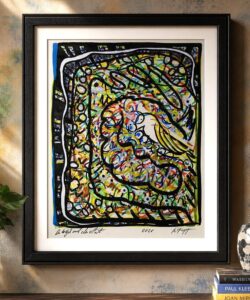
“Framed and staged, this masterpiece, “The Bird and the Nest” (2026, acrylic and watercolor on paper, 50 x 65 cm), becomes a manifesto of creative power.”
The Paradox of Abundance: A Cosmic Emblem
Klaus does not reduce form out of scarcity, but rather out of a profound artistic intention. He is not painting a decorative songbird, but creating an iconic primal symbol. The image possesses the visual force of a historical stamp or seal.

Instead of sentimentally romanticizing the event, the composition conveys brood care as an elemental, existential necessity—as an inner, sacred duty. The golden bird in the right center embodies the pure, concentrated energy of the protective instinct. It is embraced by a vast, cloud-like spiral line that resembles a metaphysical placenta. The green leaf at the edge acts as a biological anchor: It shows that this cosmic protective function is firmly rooted in earthly, organic life.
The visual nervous system: The vibrant all-over
The actual visual result radically breaks with any notion of simplistic representation. The surface operates with a breathtaking micro- and macrocosmic density:
The synaptic network: Beneath the dominant structures, a dense neural tissue pulsates, composed of countless red, blue, yellow, and green sweeping lines. It is like looking through a microscope at living, vibrating cells.
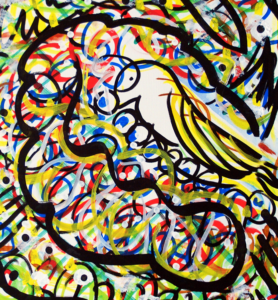
The taming by the black line: Over this primordial chaos of creation, Klaus lays his powerful, bold, black contour lines with sleepwalker-like certainty. They capture the exploding splendor of color and force it into an unshakable, lasting order. At the bottom edge, circular ciphers with dots also form—symbols for eggs, germs, and unborn life.
The Simplicity of the Subject
The nest here is not an object. It is a state of being.
It is not “a constructed nest.” It is a force field of preservation. The subject is simple: bird, nest, eggs. But simple subjects are not automatically simple images. On the contrary: the more primal a motif, the more dangerous it becomes for the artist. A bird in its nest can immediately become sentimental, decorative, or childishly harmless. That doesn’t happen here. Why not? Because the image doesn’t rely on sweetness. Everything is in motion, everything vibrates, everything is vulnerable and protected at the same time. The image shows care not as softness, but as vigilance.
The Bird
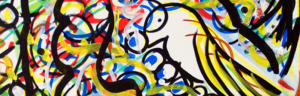
The bird does not appear passive. It sits, but it does not sleep. It incubates, but it does not disappear into idyllic repose. The body is delicate and strong at the same time. This is very beautiful, because true care is precisely that: not sentimental, but tireless. The image shows this inner duty. The bird does not protect because it is kind. It protects because life needs protection before it can emerge.
The Eggs
The many round shapes in the image are crucial. Some resemble eggs, others eyes, seeds, cells, moons, dots, symbols. They are repeated throughout. This means the motif of the egg is not just shown in one place, but distributed across the entire image. The egg becomes a principle. It says: Possibility is everywhere. Unborn life is everywhere. There is something everywhere that needs to be protected, warmed, ordered, or incubated. This is not neutral. This is powerful.
Is the image too simple?
No. It is easy to read, but not superficial. The danger with this image lies more in believing you’ve understood it too quickly. You see the bird, the nest, the eggs—and think: That’s clear. But then the image begins to work. You realize that the nest is much larger than the bird. You realize that the bird is sitting in an almost overwhelming world. You realize that the eggs appear everywhere. You realize that protection and chaos coexist. The depth doesn’t lie in a hidden, complicated narrative. It lies in the archetypal seriousness of the motif. That’s very KFH: Everything is transition. Even the nest isn’t the endpoint, but preparation.
The Connecting Element
This is deeply connected to Klaus’s larger body of work: horsemanship, coaching, art. Because there, too, it’s always about creating conditions in which a being can reveal itself without being broken. A coach can’t “hatch” anyone. A horseman can’t force trust. An artist can’t complete a painting through violence. But you can hold a space in which something is allowed to emerge. This image speaks precisely to that. For me, the most powerful idea of this image lies in the connection between strength and tenderness. The nest is tender, but not weak. The bird is caring, but not cute. The eggs are vulnerable, but they carry the future. The frame is hard, but it protects life. The spiral is wild, but it gathers. This is a mature understanding of care. Not: softening everything. But: holding the vulnerable in such a way that it can develop.
The Secret of the Magnetic Effect
The phenomenon that this painting magically draws the viewer in and compels them to linger is based on two specific compositional mechanisms:
The Infinite Cycle: There is no vanishing point for the eye. Following the thick black lines, one is inevitably led back to the center, to the golden bird, in a spiraling movement. The composition is perfectly self-contained.
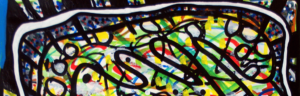
The Optical Resonance: The layering of fine, colorful hues beneath the hard contours creates a shimmering depth effect. The image is never still; it resonates in the viewer’s eye, generating a vibrant, meditative stillness.
Conclusion
“The Bird and the Nest” is a milestone. It proves that Klaus has taken “wildness” to a new level: He no longer runs wild in free chaos, but rather in the monumental condensation of the life principle. He combines the untamed power of color in Expressionism with the rigorous discipline of an icon painter. An absolutely masterful, complex and extremely powerful image that represents a supporting pillar.
Key statements:
The nest here is not a place of coziness, but a first architecture of creation.
Care appears not as sentimentality, but as strength, alertness, and an inner duty.
The egg is life’s smallest promise—and the entire image protects this promise.