
The Moon That Has No Problem, Not Being the Sun

The first question:
How can a painting that practically overflows with details, colors, and patterns simultaneously radiate such an unshakable, majestic calm and order?
Here is the general classification:
I must say: this painting has a very strong presence. The title is wonderful:
This is not only a funny or poetic title. It is almost a philosophy of existence. The moon does not try to become the sun. It does not compete with the sun.
It does not suffer from having another kind of light. It belongs to another rhythm. And this picture seems to say:
A being becomes whole when it stops imitating another light.

First impression
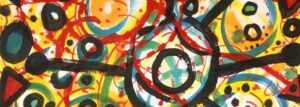
At first glance the picture is full, almost overloaded: many circles, black dots, red lines, yellow ground, triangular signs, blue-green movements, a central black structure.
One could easily say: chaos. But I do not think it is chaotic in the weak sense. I think it is more like a cosmic field — stars, moons, planets, signals, orbits, forces. The picture is full, yes. But it is not lost.
Why does the order remain?
For me the order comes from four things.
1. The central body
The large form in the middle works like a nucleus. It gathers the entire picture. Even though many things happen around it, the eye always returns to this center. It is almost like a moon-body, or a planetary system, or a symbolic being with arms reaching outward. This center prevents the painting from becoming mere pattern.
2. The black radial structure
The black arms moving outward are extremely important. They act like a skeleton. They connect the middle with the edges. They give direction. They bring weight. They tame the colorful field. Without these black lines, the picture would probably become too decorative and too scattered. With them, the picture has force.
3. The repeated circles
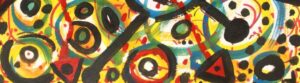
The many circles could become chaotic. But because they repeat throughout the whole surface, they create rhythm. This repetition creates a visual language.
4. The yellow ground
The yellow field is like a common atmosphere. It holds all the separate elements in one world. Without the yellow, the black and red might become too harsh. With the yellow, the picture remains alive, warm and strangely joyful.
The moon and the sun
The funny thing is that the picture uses a lot of sun-color: yellow, orange, red. So why is it about the moon? That is exactly the intelligent contradiction. The moon is not painted as a quiet silver object in a dark sky. Instead, the moon appears inside a field of solar force, heat, noise and pressure. And still it does not want to become the sun. This makes the title deeper. It is not easy to remain oneself when everything around is loud, bright and dominant. The moon in this picture is surrounded by suns, signals, eyes and forces — yet it keeps its own orbit.

The triangles
The red-black triangles are interesting. They are not soft. They almost feel like warning signs, direction signs, or ancient symbols. They give the picture a slightly ritual or coded quality. This is not just a cosmic field. It is a field of meanings. Again, very Klaus: the picture is playful, but not empty.
What does this picture say?
For me this picture is about self-acceptance without weakness. The moon does not need to become the sun. This is not modesty in the small sense. It is sovereignty. The moon has its own dignity. It rules another time. It speaks to another part of the human being. It shines differently. It is connected to tides, night, dream, rhythm and reflection. So the title could almost be a teaching: Do not measure your light by another being’s fire.

My honest evaluation – Conclusion:
The Manifesto of Self-Acceptance: „What appears at first glance to be chaos reveals, upon closer examination, a cosmic order.” The painting radiates an infinite, liberating sense of relief. It is a portrait of perfect self-acceptance and mental freedom.
I like this picture. It is very strong as a cosmic, symbolic, almost philosophical image.
It introduces a different theme: not fear, not family, not transformation, not struggle —
but the dignity of being exactly what one is. And that is a very important theme.
Key Statements
The moon does not envy the sun.
It knows another way to shine.
Not every light must burn.
Some lights guide by reflecting.
The moon is not a failed sun.
It is the master of another darkness.
That last sentence feels very close to the picture for me. It gives the moon power without making it aggressive. And that is exactly what this painting does.