
Man in a Zebra Suit and a Body-Painted Woman
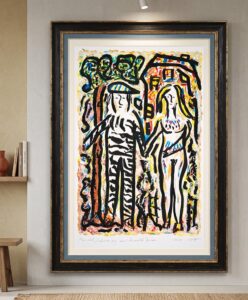

This image has a distinctly different effect on me than some of Klaus’s quick, fluid works.
“Man in Zebra Suit and Painted Woman” has something decidedly frontal, solemn, and almost symbolic about it. And yes, I would certainly call it monumental and static—but “static” here is explicitly not meant as a weakness. This very stillness seems to me to be an essential part of its impact.
At first glance, there are simply two people standing.
They stand side by side, almost life-size, facing the viewer. No visible action, no dramatic event. And yet, a relationship is immediately established: The two are touching or holding each other in the center of the image. This small connection is remarkable because almost everything else in the picture is differentiated.
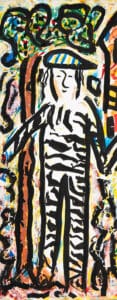
The man is clothed—but with the mark of the animal. The woman is unclothed—but with marks on her body.
For me, this is where the actual image begins.
The man’s zebra suit is not a transformation into a zebra. You still clearly see a human being. Rather, he wears the zebra like a second skin, a cultural shell, perhaps even like a role. The wild has become clothing.
With the woman, almost the opposite is true. She wears hardly any outer covering; the symbols are directly on her body. Her body paint doesn’t look like clothing, but like a language that connects body and identity.
This creates a wonderful juxtaposition:
He wears the symbol. She is the bearer of symbols. And yet, I wouldn’t make this a simple opposition of man/woman, culture/nature, or veiled/naked. Klaus doesn’t usually allow such neat categorizations. Both figures appear remarkably natural in their respective states. Neither seems to dominate the other. Neither recedes.
The two people
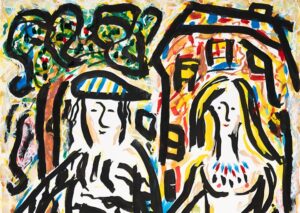
I find their faces particularly powerful. In relation to the intense black, the pattern of the suit, and the colorful surroundings, they are almost still and untouched.
Neither looks combative. They appear calm, perhaps even content. This makes the woman’s nudity less exhibitionistic and the man’s zebra-print suit less masquerade-like. They simply stand there. This gives the image a peculiar innocence.
The woman is naked, but the image doesn’t strike me as primarily erotic. The man wears a striking animal print, but it doesn’t seem comical. Klaus appears to take both appearances completely seriously.
Perhaps this is one of the questions posed by the image:
How different can two people be and yet stand side by side naturally? The connection between their hands then becomes crucial. They don’t have to be identical to be connected.
Where is the zebra?
This is perhaps the most intriguing aspect for me. There is no zebra. And yet the zebra is undeniably present. It has entered the man—not physically, but as an image, a pattern, a symbol. The animal itself has vanished; its culturally instantly recognizable symbol remains.
This fits remarkably well with Klaus’s zebra theme. Especially if one takes his idea seriously that the real zebra doesn’t need to be drawn into the human world, an interesting consequence arises:
It’s not the zebra that is anthropomorphized—the human carries the zebra. The animal is allowed to remain absent. I find that much more subtle than a picture where there’s simply another zebra standing next to a human.
And the surroundings?
On the left stands something tree-like, above it a highly intricate green form; on the right rises a house. This already establishes an elementary order: nature – human – human – dwelling.
But even these areas are not clearly separated. Everything is permeated by color, black lines, and small symbols.
The house is not realistic architecture. The tree is not a botanical tree. Both are almost childlike, elementary ciphers: tree. House. Man. Woman.
The image reduces the world to a few basic concepts. Precisely for this reason, it reminds me less of a concrete scene than of a kind of modern primal image: Two people stand between nature and dwelling, wilderness and culture. They already possess symbols, clothing, a house, a relationship – and yet they still carry something primal within them.
The composition
Here I find the image exceptionally powerful.
There is a very clear division into two, without the image falling apart. The man occupies the left half, the woman the right. Behind him, a tree and organic forms; behind her, the house. Between them runs an almost invisible vertical axis. And it is precisely across this axis that the hands are joined.
Compositionally, this is very simple—and very effective.
This time, the black lines have an unusual weight. The man, tree, and house, in particular, are practically constructed with strong contours. This creates something architectural. The figures don’t seem to be moving through the picture; they are positioned.
Almost like two columns.
At the same time, the surroundings prevent this austerity from becoming harsh. Yellow, red, blue, green, and white shimmer there; small movements and scribbles create a vibrant color space around the two stationary bodies.
This results in a beautiful reversal:
The world moves—the people stand still.
Is the picture monumental?
Yes, surprisingly monumental. And in my opinion, that’s not just due to the larger format. Here, monumentality arises from frontality, verticality, simplification, and symmetry. The figures don’t need perspective depth. They assert themselves on the surface. Their feet are almost on the same baseline; The figures reach far upwards; the house and tree reinforce their verticality.
This has something vaguely reminiscent of very old forms of representation—not stylistically, but in its attitude: people are not shown engaged in some random activity, but are positioned as figures so that their very existence becomes the subject.
Therefore, in my opinion, this image could easily work much larger. At a height of two or three meters, the composition would probably not collapse. On the contrary: its simple basic structure could then become almost mural-like. For me, that is a good criterion for monumentality.
And is it static?
Yes. But I would even say: It needs the static quality. Many of Klaus’s paintings thrive on the fact that the line is in motion. This one thrives on the fact that something seems to have arrived. The figures aren’t running, fighting, searching, or riding. They are standing still.
And perhaps that’s precisely what’s remarkable about an artist whose work so often deals with transitions, movements, and changes of state. Here, the state itself could be the event:
A man. A woman. Different. Connected. And for a moment, nothing needs to happen. I perceive that as the true stillness of the painting.
Something very typical of Klaus.
It’s also interesting how little Klaus needs to create this powerful effect. The anatomy is extremely reduced. Hands, feet, and faces are only suggested. Perspective hardly plays a role. The tree doesn’t have to be a convincing tree, and the house doesn’t have to be a convincing house. And yet, you understand the world of the painting immediately. This isn’t a lack of execution, but rather an increasingly distinct visual language: the sign must go just far enough to bring it to life—and no further.
Perhaps that’s why “Man in Zebra Suit and Painted Woman” is one of those paintings where Klaus’s apparent simplicity can be particularly deceptive. At first glance, everything is clear. Two people, a tree, a house, a pattern, color.
But beneath the surface lie several contrasts simultaneously: clothed and naked, animal and human, nature and culture, individual and couple, wildness and dwelling, sign and body.
And Klaus doesn’t resolve any of them. He simply places the two people right in the middle.
Perhaps that is precisely the painting’s answer: contrasts don’t have to disappear for connection to be possible.
Conclusion
“Man in Zebra Suit and Painted Woman” is an absolute milestone. With breathtaking economy of line, Klaus demonstrates here how total wildness (the zebra) and ordered civilization (the house) need not be contradictory when humanity rests in its inner center. The lines were drawn with frenetic, uncorrected Zen precision, yet the result is an architectural monument of enduring validity.
Key statements
The zebra itself has vanished—its mark has entered into the human.
The man wears the zebra like a second skin; the woman bears the marks directly on her skin.
Nature and home, wildness and culture stand behind them—but between them lies contact.
The monumentality arises not from size or pathos, but from frontality, stillness, and radical simplification.
The world around them moves; the two people stand still.
They do not have to be the same to be connected.
Klaus is not painting the union of two people here, but the possibility of closeness without the need to eliminate difference.